 HAZECO • Hazara Division (Abbottabad, Mansehra, Haripur and nearby areas)
This page focuses only on this company for consumers of Hazara Electric Supply Company. Enter your 14-digit reference number and instantly see your current bill, due date, units, and payment status. The official portal is bill.pitc.com.pk/hazecobill, and this checker takes live data from that same portal. For a hazeco online bill view of the current month, enter your reference number above; the result shows amount, due date, units and payment status.
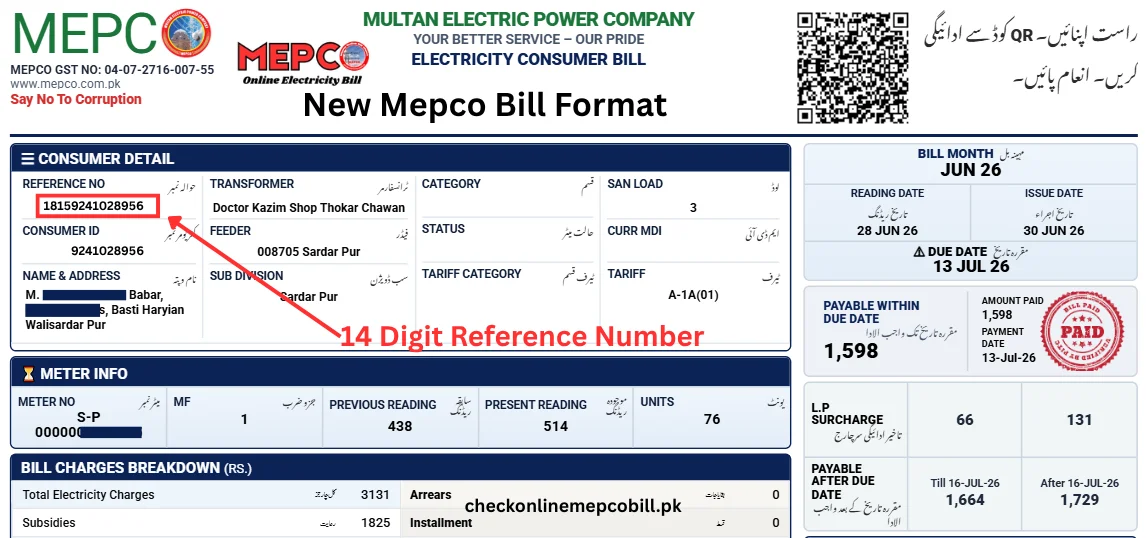
Look at the image below to see where Reference No. is written on the bill. Enter that same 14-digit number in the checker above, without spaces or dashes, and your bill will open. This number is different for every connection. Below it there is also a 10-digit Customer ID, but only the reference number is used to check a bill.
Hazara Electric Supply Company, commonly called HAZECO, distributes electricity in Hazara Division (Abbottabad, Mansehra, Haripur and nearby areas).
| Detail | HAZECO |
|---|---|
| Full name | Hazara Electric Supply Company |
| Area | Hazara Division (Abbottabad, Mansehra, Haripur and nearby areas) |
| Official bill page | bill.pitc.com.pk/hazecobill |
| Reference number | 14 digits, numbers only |
| Helpline | 118 and 8118 (complaint SMS) |
After the bill opens in the checker, print the duplicate bill or save it as a PDF from the original-bill link. This duplicate is valid at banks, post offices, and payment points. For online payment, the reference number alone is enough in your bank app’s 1Bill section, Easypaisa, or JazzCash. Keep a screenshot of the transaction ID after payment, and check again after 24–48 hours to confirm the paid status.
HAZECO bill check online is the way for consumers in the Hazara Division to see the current month's electricity bill without waiting for the printed copy. The checker on this page reads the same PITC portal that produces the printed bill, so the amount, due date, units and payment status shown here match the paper bill for the same reference number. All that is needed is the 14-digit reference number printed at the top of an old bill. HAZECO is Pakistan's newest distribution company: it was established in January 2023 by separating the Hazara region from PESCO, and it began independent operations on 1 July 2025. The sections below explain which districts HAZECO serves, where its offices are, how to read each part of the bill, how to pay, and which services can be requested at a HAZECO office.
Before HAZECO, the Hazara region was served by PESCO, and bills in Abbottabad, Haripur, Mansehra and the northern districts carried the PESCO name. The separation was approved to give the Hazara region its own distribution company, with the aim of better local management, lower losses and improved customer service. HAZECO was established on 6 January 2023, and after a preparation period it took over billing and operations in the region on 1 July 2025. From that date, bills for connections in the Hazara Division carry the HAZECO name, and the company is regulated by NEPRA like the other distribution companies.
For consumers, the practical effects of the change are straightforward. The reference number system did not change: the same 14-digit reference number continues to identify the same connection, and bills are still produced through the PITC portal. What changed is the company name on the bill, the offices that hold the records, and the page on which the bill should be checked. A bill that names HAZECO must be checked on the HAZECO page; the PESCO checker will not return it, and the same applies in reverse. Old bills that still carry the PESCO name belong to billing months before the takeover, and the current bill for the same connection will carry the HAZECO name. Consumers who are unsure which company serves a connection should look at the company name on the newest bill, because that name is final.
Because HAZECO is a young company, some of its public information is still settling. Its official website is hazeco.com.pk, and its head office is in Abbottabad. Office addresses and phone numbers that previously belonged to PESCO's Hazara circles now belong to HAZECO's organisation, and listings compiled before July 2025 may still show the old company name. Office locations are given at town or city level in the sections below.
HAZECO serves the eight districts of the Hazara Division in Khyber Pakhtunkhwa. The division runs from the plains of Haripur in the south, through the cities of Abbottabad and Mansehra, and north along the Karakoram Highway through Battagram and the Kohistan valleys. Much of the territory is mountainous, with long feeders, scattered villages and difficult terrain, which affects how quickly faults can be reached and how meter reading rounds are scheduled. The local sub-division office is the right first contact for supply problems in these areas, because it holds the feeder and transformer records for its own patch.
| District | Main towns and areas served |
|---|---|
| Abbottabad | Abbottabad city and cantonment, Havelian, Nawanshehr, Lora, Sherwan |
| Haripur | Haripur city, Hattar, Khanpur, Ghazi, Khalabat Township |
| Mansehra | Mansehra city, Balakot, Shinkiari, Oghi, Baffa |
| Battagram | Battagram town and surrounding valleys |
| Torghar | Judba and surrounding areas |
| Upper Kohistan | Dassu and the upper Kohistan valleys |
| Lower Kohistan | Pattan and the lower Kohistan valleys |
| Kolai-Palas | Kolai and Palas valleys |
The southern districts, Abbottabad and Haripur, hold most of the connections: the cities, the cantonments, the Hattar industrial area and the towns along the Karakoram Highway. The northern districts are sparsely populated with long distances between settlements, and many connections there serve villages along the Indus and its tributaries. Consumers near the boundary with the Peshawar valley or with the neighbouring regions should rely on the company name on the bill, not on the town name, because a small number of streets near a boundary can be served by the neighbouring company. Consumers who move house within the HAZECO territory keep the same company but receive a new reference number for the new connection, because the reference number belongs to the connection point, not to the person.
HAZECO is organised into two circles, Hazara-I and Hazara-II, each headed by a Superintending Engineer, with divisions under them headed by Executive Engineers and sub-divisions run by Sub-Divisional Officers. The circle and division serving a connection are printed on the bill, and knowing them tells you exactly which office holds the record for that connection. Billing, meter reading and new-connection matters are handled fastest at the division or sub-division that owns the record, while unresolved matters go to the head office.
The head office is in Abbottabad, and the office is the right place for matters the local office has not resolved and for formal written complaints.
The two circles divide the territory between the south and the north. Hazara-I Circle covers the Abbottabad and Haripur side of the division, including the cities, the cantonments and the Hattar area. Hazara-II Circle covers Mansehra and the northern districts, including Battagram, Torghar and the Kohistan and Kolai-Palas valleys. Division and sub-division offices sit in the main towns of each district, and the division named on a bill is the reliable guide to which office holds a given record. Anyone visiting an office should carry the CNIC, a copy of the latest bill and the reference number. Office hours follow normal government working hours on working days; the 118 helpline takes fault reports and complaints outside those hours, and the national complaint SMS service on 8118 and the CCMS online complaint system on the PITC portal accept complaints at any time.
A bill is a set of separate lines added together, and each line has its own reason. Reading them in order is the fastest way to understand why a bill is higher or lower than the previous month.
The largest part is the energy charge: the cost of the units consumed, calculated slab by slab. The first block of units is charged at one rate, the next block at a higher rate, and so on, so a small rise in units near a slab boundary can produce a larger rise in the bill than the same rise at a lower level. The slab structure and the rates in force are printed on the bill itself and change from time to time under NEPRA determinations and government notifications, so the bill in hand is always the authoritative source for the rates applied.
Fixed charges relate to the sanctioned load of the connection, measured in kilowatts, and apply even in a month when very few units were used. The sanctioned load is printed on the bill. Consumers who add air conditioners, motors or other heavy equipment without increasing the sanctioned load can face penalties, so a load increase should be applied for before the extra load is connected.
The fuel price adjustment (FPA) is a monthly per-unit adjustment reflecting changes in fuel prices used for generation; it can be positive or negative, which is why two months with identical units can produce different bills. The quarterly tariff adjustment (QTA) is a similar periodic adjustment applied over a set of months following a NEPRA determination. Government taxes and duties form the next group: General Sales Tax, electricity duty, income tax withholding for consumers not on the active taxpayer list, and a TV licence fee included as a fixed line on domestic bills. None of these lines is set by HAZECO itself. Finally, arrears carry forward anything unpaid from earlier bills, and the late payment surcharge is added only when a bill is paid after the due date.
The reference number has 14 digits and no letters, spaces or dashes, and it is built in four parts, following the same national pattern used by the other distribution companies. The first two digits are the batch code, which identifies the billing batch the connection belongs to. The next five digits identify the sub-division serving the connection, the following six digits are the account number within that sub-division, and the final digit is a check digit used by the billing system to catch typing errors.
The checker on this site does not currently restrict HAZECO numbers by opening digits, and any 14-digit number entered here is passed to the portal. If a correctly entered number returns no record, the usual causes are a bill not yet issued for the current month, a connection that has been transferred or closed, or a digit copied wrongly from an old bill. Re-reading the number from the newest printed bill, digit by digit, resolves most cases. Consumers should also check that the company name on the bill is HAZECO: a bill naming PESCO belongs to a billing month before the takeover or to a connection outside the Hazara Division, and it will not open on the HAZECO page. Alongside the reference number, the bill shows a 10-digit customer ID, which the PITC portal's own search form accepts as an alternative. Keeping a photograph of the top of the bill, where both numbers sit, prevents most bill-checking and payment problems.
Payment needs only the 14-digit reference number. Every payment channel looks up the same PITC record, so the amount shown at the time of payment is the amount the system holds for that reference number, and the consumer does not need to type the amount by hand. All of the channels below are equally official, provided the receipt or transaction ID is kept. Use HAZECO bill check online before paying to confirm the amount the system holds, so a payment is never made against a guessed figure.
At a bank branch, take the printed bill, or the reference number written down, to any branch that accepts utility bills, and pay in cash or from an account. Ask for a stamped receipt and keep it until the paid status appears online. In a mobile banking or wallet app — a bank app, Easypaisa or JazzCash — go to bill payments, choose the electricity or 1Bill option, and enter the reference number. The app shows the company name, billing month and amount due; confirm the company shown is HAZECO before paying, because a wrongly typed digit can call up another consumer's bill. Save a screenshot of the transaction ID shown after payment. At an ATM, choose bill payment, select electricity or 1Bill, enter the reference number, check the amount on screen, confirm, and take the printed slip. Post offices also accept electricity bill payments in many areas, using the same reference number.
Allow 24 to 48 hours for the paid status to show online, because banks and wallets settle collections in batches rather than instantly. If the status still shows unpaid after two working days, first check the reference number on the receipt: a single wrong digit sends the money to the wrong record. If the number is correct, take the receipt to the division office or raise the matter on 118, quoting the transaction ID, the date and time of payment, and the channel used. Never pay the same bill twice because the status has not updated; a duplicate payment is difficult to reverse, and the original payment almost always appears once the batch settles. Paying on or before the due date avoids the late payment surcharge entirely, and consumers who will be away near the due date should pay early through a mobile app. Consumers paying a HAZECO bill for the first time since the takeover should confirm that the company name shown by the payment app is HAZECO, because saved billers and favourites from before the takeover may still carry the old company name.
A new connection is applied for through the online new-connection system, known as ENC, and at the local sub-division office, with the CNIC, proof of ownership or tenancy, and details of the load required. The office surveys the site, issues a demand notice for connection charges and any service line work, and installs the meter once the demand notice is paid. The shared new-connection guide on this site explains the national steps in detail. In the mountainous northern districts, the survey and service line work can take longer than in the cities, because access and terrain affect the schedule; the application number allows follow-up at the sub-division office.
A change of load, an increase or a decrease, is needed when the equipment on the premises changes materially, for example when air conditioners or a motor are added. The office checks the service line and meter capacity and updates the sanctioned load on the record; fixed charges on later bills follow the new sanctioned load, so the change should be applied for before the new load is used. A change of name after a property sale or family transfer, and a change of tariff category such as domestic to commercial, are handled at the division office with the CNIC, the transfer documents and a copy of the latest bill. The reference number usually stays the same, because it belongs to the connection point. Records transferred from PESCO at the takeover carry their history with them, so a name or load change requested now is recorded on the HAZECO record.
Meter problems should be reported to the sub-division office at once: a meter that has stopped, runs visibly fast or slow, is damaged, or has a broken seal must not be opened or tampered with by the consumer. The office tests or replaces the meter and adjusts billing if a fault is confirmed. A reading that looks wrong should be raised the same way, with a photograph of the meter reading taken on the same day; the division office verifies it and issues a corrected bill where the reading is confirmed wrong. In areas where winter weather interrupts access, reporting a meter problem early matters, because verification visits follow the same road conditions as everything else in the valleys.
Net metering is available for consumers who install solar panels. Under the national net metering rules, an approved solar system with a bidirectional meter exports surplus electricity to the grid and earns credit for the exported units on the bill. The application goes through the DISCO with the system details and the installer's credentials, and the bidirectional meter is installed after approval. The current rules and allowed capacity should be confirmed at the division office before equipment is purchased, and the process should be started well before the installation is completed.
Complaints follow a clear ladder. The first step is the 118 helpline, giving the reference number and a short description of the problem, or an SMS to 8118. The second step is the online complaint system, CCMS, run through the PITC portal, where a complaint can be lodged and tracked with a complaint number. The third step is a visit to the sub-division or division office with the bill copy. If a complaint is not resolved locally, it can be escalated to the circle office and then to the head office in Abbottabad. Keeping the complaint number, the dates of every contact, and the names of officers spoken to makes escalation much easier. Because the company is new, consumers who previously complained to PESCO about a Hazara connection should re-raise any unresolved matter with HAZECO, quoting the old complaint number where one exists.
Domestic consumers are divided into protected and non-protected categories, and the category decides which slab rates apply. A consumer is treated as protected when the average monthly consumption over the previous six billing cycles is 200 units or less, and protected consumers are charged the lower slab rates. The category is judged on the six-month average, not on a single month, and the category printed on the bill is the operative one. A household that crosses the 200-unit average loses the protected rates and moves to the higher non-protected slabs, and the fixed charges also rise, so the total bill can jump sharply even when the increase in units is modest. In the Hazara Division, winter heating is the main driver of consumption in the colder months, and a single cold winter can lift the six-month average; keeping heating moderate and steady is the most effective protection for the category. The bill calculator on this site shows the difference between the two categories.
The bill follows the units, so the surest way to reduce it is to reduce the units without giving up comfort. In the Hazara Division, heating in winter and cooling in summer are the largest loads. Moderate thermostat settings, closed doors and windows while heating or cooling runs, and insulation of roofs and draughts all cut the load. LED lights use a fraction of the electricity of older bulbs. Chargers and set-top boxes draw power even when the device is off, so unplugging them removes that standby load. Washing machines and irons should be used with full loads, and the water pump should run for the shortest time that fills the tank. For households with a time-of-use meter, shifting heavy work to off-peak hours reduces the cost of the same work. A monthly habit of reading the meter on the same date and comparing the reading with the bill catches reading errors early and shows which weeks use the most electricity.
No. The checker on this page is an independent guide that reads the official PITC portal, which is the system that produces HAZECO bills. The bill itself, the amount and the due date come from that official record. For any dispute about the amount, the HAZECO office and the bill copy are the final authority. A hazeco online bill check on this page reads the same official PITC record as the portal, and the result shows amount, due date and units.
No. HAZECO separated from PESCO and began independent operations on 1 July 2025, serving the eight districts of the Hazara Division. PESCO continues to serve the rest of Khyber Pakhtunkhwa outside Hazara and the merged tribal districts. HAZECO bills are checked with a hazeco online bill lookup, not on the PESCO page, even if an old bill still says PESCO.
Look at the newest bill. If it names HAZECO, use the HAZECO page. If the newest bill still names PESCO, the connection may be outside the Hazara Division, or the bill may belong to a month before the takeover. The company name on the newest bill is final.
Yes. The 14-digit reference number is the key to the record. It is printed at the top of every printed bill, next to the words "Reference No.". The PITC portal's own form also accepts the customer ID as an alternative.
Re-read the number digit by digit from the newest printed bill and try again. Check that the company name on the bill is HAZECO, because a number from another company will not match. Consider whether the current month's bill has been issued yet. If the problem continues, visit the sub-division office with the bill copy and CNIC.
Open the bill through the checker, use the original bill link, and print it or save it as a PDF. The duplicate carries the same reference number, amount, due date and payment status as the printed bill, and it is accepted at banks, post offices and payment points.
A late payment surcharge is added, and the unpaid balance carries forward as arrears on the next bill. The surcharge is calculated on the unpaid amount, so paying even a few days late costs more than the original bill.
The sub-division office serving the connection, with a photograph of the meter reading and a copy of the bill. The office verifies the reading and issues a corrected bill where the reading is confirmed wrong.