 WAPDA • DISCOs • PITC • Helpline 118
People call every bill a “WAPDA bill”, but the purpose of this page is to make clear whose bill it really is, what the PITC portal is, and where you should check your bill. Choose your DISCO below and check your bill by entering your reference number. This page points you to the right DISCO page, where you can check bill online with your 14-digit reference number and see the same bill the official portal shows. A quick bill check here uses live PITC data, so the amount, due date and units match the official record.
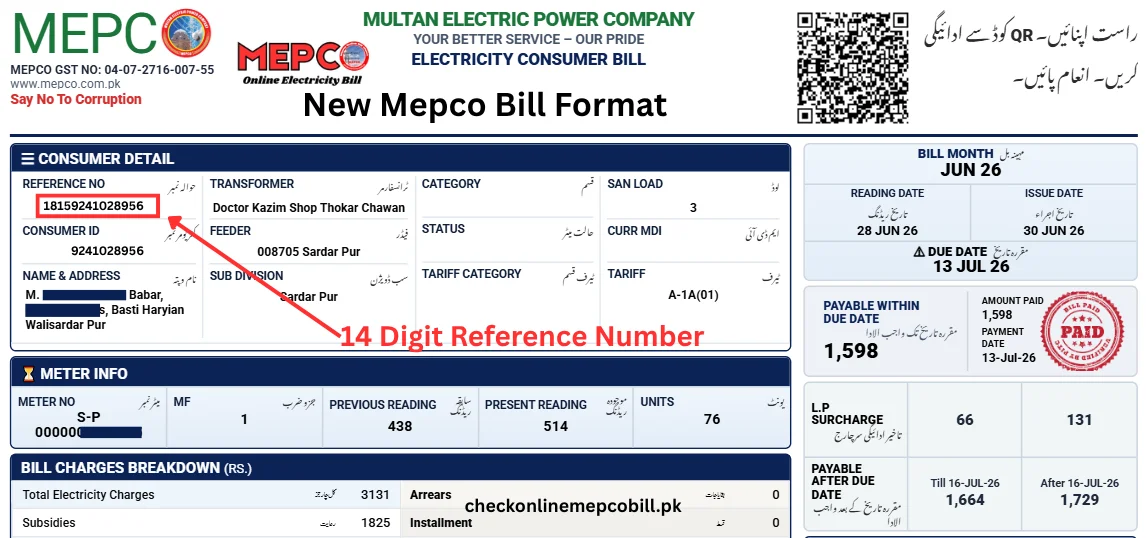
In the picture below, see where the label Reference No. is printed on the bill. Enter the same 14-digit number in the checker above, without spaces or dashes, and your bill will open. This number is different for every connection. Below it is the 10-digit Customer ID, but only the reference number is used to check a bill.
WAPDA stands for Water and Power Development Authority. In earlier times, WAPDA also handled electricity distribution, which is why people still use this name today. But after unbundling, electricity distribution was handed to separate companies called DISCOs. Today, the bill in your hand — for your home, shop or office — belongs to your area's DISCO: LESCO in Lahore, MEPCO in Multan, IESCO in Islamabad, and each other city's own company in the same way.
WAPDA's work is now mostly related to water projects and hydel power generation. That does not mean WAPDA's name has disappeared from bills — people still use it out of habit. When you check a bill online, you are actually checking your DISCO's bill, which is available on the PITC portal.
| Organisation | Purpose |
|---|---|
| WAPDA | Authority for water and hydel power; does not issue household bills |
| DISCO (such as LESCO, MEPCO) | Electricity distribution, meter reading, billing and customer service in its area |
| PITC | Power Information Technology Company; runs the online bill portal for all DISCOs (bill.pitc.com.pk) |
| NEPRA | Regulator; complaints can be escalated here if the DISCO does not resolve them |
| Company | Area | Bill page |
|---|---|---|
| LESCO | Lahore, Kasur, Sheikhupura, Okara, Nankana Sahib | LESCO page → |
| MEPCO | 13 districts of South Punjab | MEPCO page → |
| FESCO | Faisalabad, Sargodha, Jhang, Mianwali, Khushab, Bhakkar, Toba Tek Singh, Chiniot | bill.pitc.com.pk/fescobill |
| GEPCO | Gujranwala, Sialkot, Gujrat, Narowal, Hafizabad, Mandi Bahauddin | bill.pitc.com.pk/gepcobill |
| IESCO | Islamabad, Rawalpindi, and from Attock to Jhelum | bill.pitc.com.pk/iescobill |
| PESCO | Khyber Pakhtunkhwa (except Hazara and the merged tribal districts) | bill.pitc.com.pk/pescobill |
| HESCO | Hyderabad and the southern districts of Sindh, except Karachi | bill.pitc.com.pk/hescobill |
| SEPCO | Sukkur region, Sindh | bill.pitc.com.pk/sepcobill |
| QESCO | Balochistan, except Lasbela | bill.pitc.com.pk/qescobill |
| K-Electric | Karachi and nearby areas | ke.com.pk (not part of PITC) |
Karachi consumers get K-Electric bills, which are not part of the PITC system. Consumers in Karachi should therefore check their bills on K-Electric's own website or app.
Electricity helpline 118 is common to all DISCOs. It is a toll-free, 24/7 number. You can complain on it about outages, faults, overbilling, meter issues or load shedding. For SMS, message 8118 with your reference number. For online complaints, use the PITC CCMS portal, ccms.pitc.com.pk, and the email address is ccms@pitc.com.pk. If a complaint is not resolved, you can write to quality assurance at qaccms@pitc.com.pk.
When calling, keep these ready: your reference number, your name, your address or feeder name if you know it, and the details of the problem. After the call, note the complaint number you receive by SMS. That number is what you need for tracking. If someone asks you for money in a personal account or asks for your OTP/PIN in the name of a complaint or bill, they are not official — end the call at once and verify again from the official number. Also keep a record of your complaint history, because if the company does not resolve it, that same history has to be shown to NEPRA. Noting the date of every call, SMS and email is in your interest, and it also shows how many days a complaint has been pending. If an outage is long, also confirm with other consumers in your area whether the problem is only at your home or on the whole feeder, because the company fixes a feeder problem sooner.
| Purpose | Number / Channel |
|---|---|
| Electricity helpline | 118 |
| Complaint SMS | 8118 |
| MEPCO toll-free | 0800-63726 |
| LESCO toll-free | 0800-00118 |
| Online complaint | ccms.pitc.com.pk |
A WAPDA bill check online is a search for a bill that WAPDA itself no longer issues, and the reason lies in a restructuring that took place a generation ago. The Water and Power Development Authority was created in 1958 under the WAPDA Act, as a statutory corporation charged with developing water and power resources on a national basis. Before that, electricity and irrigation had been handled by separate provincial departments. WAPDA brought them together under one roof, with three wings: water, power and finance. For the next four decades it built the dams, power stations, transmission lines and distribution networks that still form the backbone of Pakistan's electricity system, including the Tarbela and Mangla dams and the grid that carries their power to every province.
By the early 1990s, the government had decided that a single authority could not run generation, transmission and distribution efficiently, and that private investment needed a regulator and a market structure. A strategic plan for restructuring the power sector was approved in 1992, and the Regulation of Generation, Transmission and Distribution of Electric Power Act — the law that created NEPRA — took effect in 1997. The following year, the WAPDA Act was amended to create the Pakistan Electric Power Company (PEPCO), and WAPDA's power wing was broken into separate corporate entities: thermal generation companies (GENCOs), one National Transmission and Dispatch Company (NTDC), and eight distribution companies (DISCOs) formed from the old Area Electricity Boards. The distribution companies were incorporated as public limited companies, each with its own board, licence and service territory.
The separation was completed in stages. In October 2007 the power wing was formally bifurcated from WAPDA, leaving WAPDA responsible for water and hydropower development while PEPCO and the corporate entities took over thermal generation, transmission, distribution and billing. The family of distribution companies then grew: TESCO serves the tribal areas, SEPCO was carved out of HESCO's territory in 2010 to serve upper Sindh, and HAZECO was separated from PESCO in 2023 to serve the Hazara division. Together with K-Electric, which serves Karachi as a private utility outside the PITC system, the eleven government-owned distribution companies now cover the whole country. When a consumer today performs a WAPDA bill check online, the search runs through the PITC portal to the distribution company that serves the address — not to WAPDA, which kept the dams and the water, and gave up the billing.
The electricity system now has several distinct actors, and confusing them is the most common reason a consumer writes to the wrong office. The table below sets out each actor's role in plain words.
| Organisation | Role today |
|---|---|
| WAPDA (Water and Power Development Authority) | Water resource development and hydropower generation; builds and operates dams and hydel stations; headquarters at WAPDA House, The Mall, Lahore; under the Ministry of Water Resources |
| Ministry of Energy (Power Division) | Federal policy for the power sector; administrative control of the government-owned power companies; notifies tariffs determined by NEPRA |
| NEPRA (National Electric Power Regulatory Authority) | Independent regulator created by the 1997 Act; licences generators, transmitters and distributors; determines tariffs and service standards; handles consumer complaints that DISCOs have not resolved |
| NTDC (National Transmission and Dispatch Company) | Owns and operates the high-voltage national transmission grid; moves power from generators to the distribution companies |
| GENCOs | Government-owned thermal generation companies; produce electricity from thermal plants and sell it into the system |
| DISCOs (LESCO, MEPCO, FESCO, IESCO, GEPCO, PESCO, HESCO, SEPCO, QESCO, TESCO, HAZECO) | Distribute electricity in their territories, read meters, issue bills, collect revenue and serve consumers; the company named on the bill |
| PITC (Power Information Technology Company) | Runs the shared billing and complaint systems for the government-owned DISCOs, including the online bill portal and the CCMS complaint portal |
| K-Electric | Private utility serving Karachi and nearby areas; licensed separately; not part of the PITC system |
Two practical consequences follow. First, WAPDA cannot correct a bill, replace a meter, or answer a complaint about a power cut, because it holds none of the consumer records; those records sit with the DISCO and on the PITC system. Second, the DISCO cannot change the tariff on its own: NEPRA determines the tariff, the federal government notifies it, and the DISCO applies it. A complaint that "the rate is too high" is therefore a matter for the regulatory process, while a complaint that "my reading is wrong" is a matter for the DISCO's sub-division. Knowing which is which decides where the complaint should go.
Older consumers remember a single bill headed by WAPDA. That bill came from an era when one authority generated, transmitted and distributed electricity. The bill a consumer receives today looks similar — the same kinds of fields, the same habit of paying at a bank — but the institution behind it has changed in ways that matter when something goes wrong.
The first difference is the issuer. The name at the top of a modern bill is the distribution company for the area: LESCO in Lahore, MEPCO in Multan, HESCO in Hyderabad, and so on. WAPDA's name survives in everyday speech and in the names of office buildings, such as WAPDA House in Lahore and the WAPDA Offices Complex in Hyderabad, but it does not appear as the issuer of a household bill. The second difference is the system behind the bill. Modern DISCO bills are produced on the PITC billing system, which serves eleven distribution companies through one portal, bill.pitc.com.pk, with a separate path for each company. The third difference is the complaint route. A WAPDA-era consumer complained to the local WAPDA office; a modern consumer complains to the DISCO's sub-division, to helpline 118, or on the PITC complaint portal, CCMS, and can escalate to NEPRA with a tracking number.
What has not changed is the reference number. The fourteen-digit number that identifies a connection has survived the restructuring, and it remains the key to checking, paying and complaining about a bill. The fields on the bill — consumer name, tariff category, sanctioned load, meter number, readings, units, due dates, arrears and the charge breakdown — are also recognisably the same, because the billing logic did not change when the institutions did. That continuity is useful: a bill from twenty years ago and a bill from this month can be read with the same knowledge, even though they were issued by different organisations.
PITC, the Power Information Technology Company, is the least visible and most important part of the modern billing system. It is the state-owned information technology company that runs the online bill portal used by the government-owned distribution companies. Each company has its own path on the portal — for example, bill.pitc.com.pk/lescobill for LESCO, /mepcobill for MEPCO, /hescobill for HESCO — but the underlying system is one, which is why the bill layout, the reference number format and the complaint system are the same across companies.
PITC also runs the Customer Complaint Management System, CCMS, at ccms.pitc.com.pk, where complaints are filed against the fourteen-digit reference number and tracked with a complaint number. Because CCMS is monitored centrally, a complaint filed there cannot be quietly set aside at a local office; the record, the dates and the escalation path are all visible. PITC's systems also sit behind the DISCOs' own apps and service portals, which draw on the same billing record. This is why a bill checked on this independent site, on the PITC portal, and on a DISCO app shows the same amount: all three read the same record, and none of them creates a separate bill.
For the consumer, the practical point is simple. The company name on the bill decides which portal path and which sub-division apply, and the reference number is the key to all of them. A WAPDA bill check online is therefore not a search of a WAPDA database — no such household billing database exists — but a search of the DISCO's record on the PITC system, reached by choosing the right company first.
WAPDA's present work is large, but it is not retail electricity. The authority owns and operates twenty-two hydel power stations with a combined installed capacity of about 9,459 megawatts, and it maintains the Tarbela Dam, Mangla Dam and Chashma Barrage, whose combined live water storage is about 13.3 million acre feet, providing water for irrigated agriculture and helping to moderate floods in high-flow seasons. Its operating projects include Tarbela, Mangla, Ghazi Barotha and Neelum-Jhelum, and it is building eight further mega projects, including the Diamer-Bhasha Dam (4,500 megawatts of generation and 8.1 million acre feet of storage), the Dasu Hydropower Project (4,320 megawatts), the Mohmand Dam (800 megawatts) and the Tarbela 5th Extension (1,530 megawatts), scheduled for completion in phases between 2026 and 2030. The power these stations generate is fed into the national grid through NTDC and reaches consumers through the DISCOs; WAPDA does not sell it to households directly, and no household bill is issued by WAPDA for it.
WAPDA also runs hospitals and residential colonies at its project sites, and its engineering and construction work employs large numbers of staff across the provinces. None of this changes the answer to the everyday question: for a bill, a meter, a connection or a complaint, the address is the DISCO, not WAPDA House. Writing to WAPDA about a household bill only adds a forwarding delay, because the letter must travel back to the DISCO that holds the record.
Choose your DISCO (such as LESCO or MEPCO), then check your bill by entering your 14-digit reference number. WAPDA does not issue bills itself, so selecting a DISCO is essential.
There is no separate WAPDA bill. People use this name out of habit, but the bill actually belongs to your DISCO. Lahore's bill is LESCO's, and Multan's bill is MEPCO's.
Call 118, or send an SMS to 8118. For online complaints, use ccms.pitc.com.pk.
Check your DISCO's bill again. After the payment clears, you will see a paid status or zero payable. Keep your receipt safe.
Open your bill from your DISCO's page and print it or save it as a PDF from the original-bill link. This duplicate is valid at banks.
Consumers in Karachi get K-Electric bills, which are not part of the PITC system. Karachi consumers should therefore check their bills on K-Electric's own website or app.
Check the status on the CCMS portal with the complaint number you received after complaining, or quote the same number on helpline 118.
No. This is an independent checker that takes data from the PITC portal. For official work, also verify your DISCO and the PITC portal.
No. Household bills are paid through banks, 1Bill channels, mobile wallets, ATMs and post offices using the reference number, or at the DISCO's own offices. WAPDA offices do not collect household bill payments.
No. NEPRA determines the tariff, the federal government notifies it, and the DISCO applies it to the bill. WAPDA's role is water and hydropower development; it does not set household tariffs.
Because the power wing of WAPDA was unbundled into separate generation, transmission and distribution companies in the late 1990s, and the distribution companies took over billing. The connection and its reference number continued unchanged; only the issuing company changed.
No. K-Electric is a separate, private utility serving Karachi and nearby areas under its own licence. It is not part of WAPDA, not part of the PITC billing system, and its bills must be checked on K-Electric's own website or app.
The local distribution network — poles, transformers and service lines — belongs to the DISCO for the area, which maintains it through its divisions and sub-divisions. The high-voltage national grid that feeds the DISCO belongs to NTDC. Faults on the street network are the DISCO's responsibility; faults on the national grid are NTDC's.
Because making electricity and billing for it are separate functions held by separate organisations. WAPDA generates hydropower and manages water; the DISCO buys power through the grid, distributes it, reads the meter and issues the bill. The billing record, and the power to correct it, sits with the DISCO.