 TESCO • Merged tribal districts (Bajaur, Mohmand, Khyber, Kurram, Waziristan and nearby areas)
This page focuses only on this company for consumers of Tribal Areas Electric Supply Company. Enter your 14-digit reference number and instantly see your current bill, due date, units, and payment status. The official portal is bill.pitc.com.pk/tescobill, and this checker takes live data from that same portal.
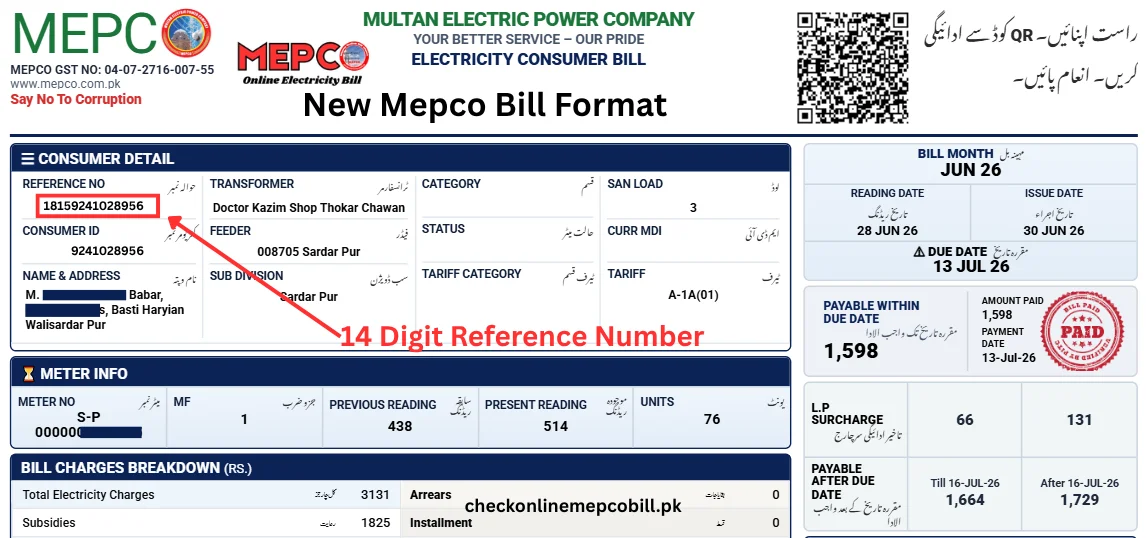
Look at the image below to see where Reference No. is written on the bill. Enter that same 14-digit number in the checker above, without spaces or dashes, and your bill will open. This number is different for every connection. Below it there is also a 10-digit Customer ID, but only the reference number is used to check a bill.
Tribal Areas Electric Supply Company, commonly called TESCO, distributes electricity in the merged tribal districts (Bajaur, Mohmand, Khyber, Kurram, Waziristan and nearby areas).
| Detail | TESCO |
|---|---|
| Full name | Tribal Areas Electric Supply Company |
| Area | Merged tribal districts (Bajaur, Mohmand, Khyber, Kurram, Waziristan and nearby areas) |
| Official bill page | bill.pitc.com.pk/tescobill |
| Reference number | 14 digits, numbers only |
| Helpline | 118 and 8118 (complaint SMS) |
After the bill opens in the checker, print the duplicate bill or save it as a PDF from the original-bill link. This duplicate is valid at banks, post offices, and payment points. For online payment, the reference number alone is enough in your bank app’s 1Bill section, Easypaisa, or JazzCash. Keep a screenshot of the transaction ID after payment, and check again after 24–48 hours to confirm the paid status.
A TESCO bill check online starts on the PITC portal, but every matter the portal cannot settle — a wrong reading, a faulty meter, a new connection, a name change — is settled at a TESCO office. In the merged tribal districts, where distances are long and terrain is difficult, knowing which office handles your area matters more than usual, and the telephone and online complaint routes often matter more than a visit.
The head office of Tribal Areas Electric Supply Company is at WAPDA House, Shami Road, Peshawar. This is the seat of the Chief Executive Officer and the company's administration, and the address used in the company's filings with NEPRA. NEPRA documents give the head office telephone as 091-9212006. Peshawar city itself is not TESCO territory — settled Peshawar is served by PESCO — but the head office sits in Peshawar because it is the provincial capital and the administrative centre for the whole of Khyber Pakhtunkhwa. Consumers do not need to visit the head office for routine work such as paying a bill, correcting a reading, or registering a complaint; those matters belong to the local field office. The head office matters when a case has passed through the lower offices without a result, or when correspondence must be addressed to the company itself.
TESCO's field offices are spread across the tribal districts, organised under divisions and sub-divisions in the same pattern as other distribution companies: divisions headed by Executive Engineers, and sub-divisions headed by Sub-Divisional Officers (SDO), with the sub-division as the office that reads meters, issues bills for its area, handles new connections, replaces meters and receives complaints. The name of your sub-division and division is printed on your bill, and it is the fastest way to find the office responsible for your connection. The reliable way to find your office is the sub-division name on your bill, the head office, or helpline 118, which can direct a caller to the right office. When you visit or call, take or quote your CNIC, a copy of your latest bill, and, for meter matters, a clear photograph of the meter showing the reading and the meter number.
For consumers who cannot easily reach a field office, the national electricity helpline 118 and the complaint SMS service on 8118 work for all TESCO areas, and complaints can also be filed on the PITC complaint portal, CCMS. These channels create a written record with a tracking number, which is why they are better than an unrecorded phone call when a matter is disputed. In areas where travel to an office takes a full day, the written record is also the practical choice: a complaint filed online or by phone is already in the system before any journey is made. Office timings follow government working hours on working days; field staff who read meters and attend faults work on rosters that cover the rest of the week, so a fault reported on a holiday is still attended, while counter work such as a new connection file is handled on working days.
| Office level | Where it sits | What it handles |
|---|---|---|
| Head office | WAPDA House, Shami Road, Peshawar | Company policy, administration, escalated cases, correspondence to the company |
| Field offices (divisions and sub-divisions) | Spread across the seven merged districts and the Frontier Regions; use the sub-division name printed on your bill to find your office | Meter reading, billing, new connections, meter replacement, first point for complaints |
| Customer service / helpline | 118 (call), 8118 (SMS), CCMS portal | Complaint registration and tracking for all TESCO areas |
TESCO is the only electricity distribution company for the merged tribal districts of Khyber Pakhtunkhwa. Its licence area is the territory of the former Federally Administered Tribal Areas (FATA) and the adjoining Frontier Regions (FR), which were merged into Khyber Pakhtunkhwa in May 2018 through a constitutional amendment. The former tribal agencies became districts of the province, and the Frontier Regions were attached to the neighbouring settled districts, but the electricity supplier for the tribal territory remained TESCO.
The seven merged districts served by TESCO are Bajaur, Mohmand, Khyber, Orakzai, Kurram, North Waziristan and South Waziristan. In addition, TESCO serves the six Frontier Regions: FR Peshawar, FR Kohat, FR Bannu, FR Lakki, FR Tank and FR D.I. Khan. The licence area covers about 27,000 square kilometres, and the company serves roughly 445,000 consumers across this territory, according to its filings with NEPRA. Settled districts of Khyber Pakhtunkhwa — Peshawar, Mardan, Swat, Bannu, Dera Ismail Khan and the rest — are served by PESCO, not TESCO, and the Hazara division (Abbottabad, Mansehra, Haripur and nearby areas) is served by HAZECO. The company name printed on the bill is the deciding fact for any consumer near a boundary. If the name on the bill is TESCO, this page is the right place for a TESCO bill check online, whatever the district.
The table below lists the seven districts with their main towns, following the former agency boundaries that became district boundaries at the merger. The Frontier Regions are smaller pockets adjoining the settled districts, administered with them but served by TESCO for electricity; a consumer in a Frontier Region will usually find the FR name reflected in the sub-division on the bill.
| District / Region | Main towns and areas served |
|---|---|
| Bajaur | Khar, Nawagai, Mamund and surrounding areas |
| Mohmand | Ghalanai, Ekkaghund, Safi and surrounding areas |
| Khyber | Landi Kotal, Jamrud, Bara and surrounding areas |
| Orakzai | Kalaya, Ghiljo and surrounding areas |
| Kurram | Parachinar, Sadda, Alizai and surrounding areas |
| North Waziristan | Miranshah, Mir Ali, Razmak and surrounding areas |
| South Waziristan | Wana, Ladha and surrounding areas |
| FR Peshawar | Frontier Region adjoining Peshawar |
| FR Kohat | Frontier Region adjoining Kohat |
| FR Bannu | Frontier Region adjoining Bannu |
| FR Lakki | Frontier Region adjoining Lakki Marwat |
| FR Tank | Frontier Region adjoining Tank |
| FR D.I. Khan | Frontier Region adjoining Dera Ismail Khan |
Three points cause the most confusion. First, Peshawar city is PESCO territory, even though TESCO's head office is in Peshawar; a bill for an address inside Peshawar city will say PESCO. Second, the Frontier Regions are easy to confuse with the settled districts they adjoin, because the town names are similar; the sub-division on the bill shows which supplier serves the connection. Third, some consumers in the tribal districts received their first formal bills only after the merger and the extension of the regular billing system, so an old connection may have a reference number that looks unfamiliar; the fourteen-digit reference number on the current bill is the number to use, and the sub-division office can confirm it where there is doubt.
Every TESCO bill carries the same set of fields, and understanding them makes it easier to spot an error early. The bill is produced on the PITC billing system, so the layout is shared with other distribution companies, but the company name, reference number and sub-division are specific to TESCO.
The reference number is the most important field. It has fourteen digits and is printed near the top of the bill under the label "Reference No." Its structure identifies the batch, the sub-division, the account and a check digit, which is why the number is unique to one connection and why entering it wrongly produces a "no bill record" result. Below it, the bill also shows a ten-digit Customer ID. The Customer ID identifies the consumer record, but the checker on this page uses the fourteen-digit reference number. Keep both numbers: the reference number for checking and paying the bill, and the Customer ID for correspondence where the office asks for it.
Next, the bill shows the consumer's name and address, the tariff category and the sanctioned load, and the meter number. The tariff category says whether the connection is domestic, commercial, industrial, agricultural or another class, and it decides which set of slab rates applies. The sanctioned load, measured in kilowatts, is the load the connection was approved for; fixed charges are linked to it, and running a much larger load than sanctioned can lead to a load notice. The meter number links the bill to the physical meter on your premises; when reporting a faulty meter, always quote this number together with the reference number.
The consumption section shows the previous reading, the present reading, and the units consumed, which is the difference between the two readings. Where the meter records peak and off-peak use separately, those readings appear as well. The billing month, the bill issue date and the due date follow. Two amounts matter most: the amount payable within the due date, and the amount payable after the due date, which adds a late payment surcharge. Paying even a day late can move the bill to the higher figure, so the due date deserves more attention than any other date on the bill.
The charges section breaks the total into parts. Energy charges are the cost of the units used, worked out slab by slab so that each block of units is charged at its own rate. Fixed charges are a standing amount linked to the connection. The fuel price adjustment, usually shortened to FPA, is a separate line that moves from month to month with fuel costs. Government charges appear as GST, electricity duty and other levies, and a television fee is included as a small fixed line. Arrears, if any, show an unpaid balance carried from an earlier bill, and adjustments or instalment lines show corrections or agreed payment plans. If any line looks wrong — a reading far above your meter, a tariff category that does not match your use, or arrears for a bill you already paid — photograph the meter, keep the payment receipt, and raise the matter before the due date so the correction can be considered in the same billing cycle. In remote areas, where the meter reader's visit can be weeks apart, a photograph taken on the reading date is the strongest evidence a consumer can hold.
A duplicate bill is a reprint of the same bill TESCO produced, and it is accepted wherever the original is accepted. After a TESCO bill check online, the bill can be printed or saved as a PDF from the original-bill view. Banks, post offices and payment points accept the printed duplicate, and the reference number on it is all that an online channel needs. If the paper bill has not arrived — a common problem in the tribal districts, where delivery can be slow and addresses are hard to reach — the duplicate is the bill; there is no need to wait for the postman before paying, and waiting can push the payment past the due date.
Payment can be made through several channels. Bank mobile apps and internet banking accept the bill through the 1Bill service using the fourteen-digit reference number. Easypaisa and JazzCash wallets and agents accept the same number, and in many tribal towns the mobile wallet agent is the most practical channel because bank branches are few and far away. Payment can also be made in person at bank branches, at ATM machines that offer bill payment, and at post offices. Whichever channel is used, the reference number must be entered without spaces or dashes, and the amount should be checked against the bill before confirming, because a payment posted to a wrong reference number is difficult to reverse. The agent's printed receipt should be kept just as carefully as a bank receipt.
After payment, keep the receipt. For an online payment, save a screenshot showing the transaction ID, the reference number, the amount and the date. For a counter payment, keep the stamped receipt. The paid status on the portal usually updates within one to two working days; checking again after 24 to 48 hours is a sensible habit. If the status still shows unpaid after that time, take the receipt to the field office and ask for the payment to be traced, rather than paying again. A second payment for the same bill creates a credit balance that must then be adjusted, which takes longer than a trace.
Consumers who cannot pay the full bill at once should speak to the field office before the due date. Distribution companies can allow payment in instalments in deserving cases, under the rules in force and with the approval of the competent officer. An instalment arrangement is not automatic and is not granted by the helpline alone; it is recorded against the connection so that later bills reflect it. Paying only part of a bill without an arrangement leaves the rest as arrears and can attract the late surcharge, so the arrangement should be confirmed in writing before relying on it.
The field office is the front door for almost every service connected with a TESCO connection. The most common requests are described below. For each of them, the office works from the reference number, so quote it at the start of any visit or call.
A new connection is applied for through the national Electricity New Connection (ENC) portal at enc.com.pk, and the application is processed by the field office for the area. The applicant selects the company and sub-division, states the connection type and load, and uploads the required documents, which generally include proof of ownership or lawful occupation of the premises, CNIC copies, an affidavit, and a wiring test report from a licensed contractor. After verification and a site survey, the office issues a demand notice showing the connection charges, the meter cost element and a refundable security deposit. The demand notice is paid at a designated bank or through a supported online channel, and meter installation follows after payment and verification. A straightforward domestic connection up to a small load is typically completed in about thirty days from a complete application, but the schedule depends on the load band, the site conditions, the terrain and verification, and the office confirms the timeline for each case. In remote and mountainous areas the site survey can take longer, so applying early and keeping the tracking ID matters more. Never pay a private agent for a connection; every official payment is made against a printed demand notice or an official voucher.
A change of load, known as load extension or load reduction, is needed when the connected load grows or shrinks — for example, after adding air conditioners or a water pump, or after removing heavy machinery. The consumer applies at the field office, the office checks the service line and transformer capacity for the area, and a revised demand notice is issued where charges apply. Running a load far above the sanctioned load without approval risks a detection bill and disconnection, so the load should be regularised before the extra equipment is used routinely.
A change of name transfers the connection to a new occupant or owner. It needs proof of ownership or tenancy, the CNIC of the new consumer, and clearance of any arrears on the connection, because arrears travel with the connection rather than the person. A tariff category correction is similar: if a domestic connection is billed as commercial, or a shop is billed as domestic, the consumer should apply for correction with evidence of the actual use of the premises, since the category decides the slab rates and the final amount.
Meter matters are handled by the field office with the help of the meter testing section. A meter that has stopped, runs too fast or too slow, is burnt, or shows a blank display should be reported promptly, with a photograph of the meter and the reading. The office can test the meter, and where the meter is found defective, the billing for the affected period is revised under the rules. In areas where the meter is mounted high on a pole or inside a locked enclosure, the photograph should be taken with the meter number visible, and the reading should be noted at the same time. Tampering with a meter, bypassing it, or breaking its seal is an offence and leads to a detection bill and legal action; a consumer who suspects the meter is faulty should always report it rather than open it.
Net metering is available for consumers who install solar or wind generation. Under the net metering regulations issued by NEPRA in 2015, a three-phase consumer can install a generation facility within a set capacity range, apply to the distribution company on the prescribed form with an electrical inspector's certificate, sign a net metering agreement, and obtain a generation licence from NEPRA. The company then installs a bi-directional meter that records both the electricity taken from the grid and the surplus sent back to it. The exported units are credited under the rules in force, which have been revised from time to time, so the current buyback treatment should be confirmed with the field office before investing in a system. Only a licensed installer should be used, and the system must not be connected to the grid before the company approves it. Solar generation is a natural fit for the tribal districts, where sunshine is strong and the grid can be unreliable, but the grid connection still needs the company's approval and meter, and the inspection stages can take longer in remote areas.
TESCO consumers have three main complaint routes, and they all feed the same record. The helpline 118 is toll-free and works around the clock for faults, outages, overbilling, meter problems and load shedding complaints. The SMS service on 8118 accepts complaints by text message with the reference number. The online route is the Customer Complaint Management System (CCMS) run by PITC at ccms.pitc.com.pk, where a complaint is filed against the reference number and can be tracked afterwards. The email address ccms@pitc.com.pk is the complaint address published for the portal. Using a channel that gives a tracking number is always better than an unrecorded visit, because escalation depends on that record, and in the tribal districts the written record is often the only practical link between the consumer and the office.
When complaining, keep four things ready: the fourteen-digit reference number, the consumer name and address, the feeder or sub-division name if known, and the facts of the problem. For a wrong reading, photograph the meter showing the reading and the meter number, in daylight, with the digits readable. For an outage, say whether the whole street or only your premises is affected, because a feeder fault is fixed differently from a service-line fault. Note the complaint number received by SMS, and note the date of every call and visit. Published service standards expect most complaints to be acknowledged quickly and resolved within about two weeks, with longer times for cases needing investigation; the tracking number is what lets a consumer show how long a case has been pending.
If the field office does not resolve a complaint, the consumer can escalate. The next step is NEPRA's Consumer Affairs Division, which takes complaints where the distribution company has failed to redress the grievance or has rejected it without justification; the complaint history from CCMS and the helpline is the evidence for that step. The Federal Ombudsman, the Wafaqi Mohtasib, also accepts complaints about maladministration by public utilities, free of charge. Courts are a last resort for billing disputes, and most billing matters are settled at the company or regulator level when the record is complete.
One safety warning matters more than any other. No genuine TESCO or PITC official will ask a consumer to send money through Easypaisa, JazzCash or a bank transfer to a personal account for a bill, a meter, a repair, a bill adjustment or a new connection, and no official will ask for an OTP or PIN. Calls and messages of that kind are fraud. End the call, do not share any code, and report the number on helpline 118.
Two ideas explain most of the variation in domestic bills: the slab system and protected status. Under the slab system, units are not all charged at one rate. The first block of units is charged at the lowest rate, the next block at a higher rate, and so on, so the average cost per unit rises as consumption rises. This is why two homes with similar habits can receive very different bills, and why a small increase in units near a slab boundary can cause a noticeable jump in the total.
Protected status is a separate idea. A domestic consumer whose average monthly use over the previous six billing cycles stays at or below two hundred units is treated as protected and is charged lower slab rates. Once that six-month average crosses two hundred units, the consumer is reclassified as non-protected, and both the slab rates and the fixed charges rise. The status is therefore about a six-month pattern, not about a single month: one heavy month does not by itself remove protection, and one light month does not by itself restore it. The bill shows the category applied, and a consumer who believes the category is wrong should raise it with the field office with the bills for the last six months in hand.
The remaining lines on the bill are easier to understand once the slab idea is clear. Fixed charges are a standing amount for the connection, linked to the sanctioned load. The fuel price adjustment reflects changes in fuel costs and moves up or down from month to month; it is set through the regulatory process rather than by TESCO itself. GST, electricity duty and other levies are government charges collected through the bill. The television fee is a small fixed charge included in every bill. None of these lines is set by the person who reads the meter, which is why a complaint about them is a complaint about the bill itself and should be filed as a billing complaint rather than argued at the meter reader's visit.
No. The PITC portal accepts the fourteen-digit reference number or the ten-digit Customer ID. A bill cannot be searched by CNIC, name or address. The reference number is printed at the top of any old bill.
Check the fourteen digits again against the old bill, confirm that the company selected is TESCO, and re-enter the number without spaces or dashes. If the number is correct and the message persists, the bill for the current month may not have been issued yet, or the connection record may need correction at the field office.
No. Peshawar city is served by PESCO. TESCO serves the seven merged tribal districts and the six Frontier Regions, and its head office happens to be in Peshawar. Go by the company name printed on the bill.
Yes. A printed duplicate from the original-bill view is accepted at banks, post offices and payment points, and the reference number on it works for online payment through 1Bill, Easypaisa and JazzCash.
Usually within one to two working days. Check again after 24 to 48 hours. If the status is still unpaid, take the payment receipt to the field office and ask for the payment to be traced instead of paying again.
Call helpline 118 or send an SMS to 8118 with your reference number. Say whether the whole street is affected or only your premises, and keep the complaint number sent by SMS for follow-up.
In deserving cases the field office can allow payment in instalments with the approval of the competent officer. Apply before the due date and get the arrangement recorded against the connection; paying part of a bill without an arrangement leaves the rest as arrears.
Apply to the field office under the NEPRA net metering regulations with the prescribed form and an electrical inspector's certificate, using a licensed installer. After technical review, an agreement is signed, NEPRA issues a generation licence, and a bi-directional meter is installed. Confirm the current buyback and fee treatment with the office before investing, because the rules have been revised over time.